GHK-Cu and collagen synthesis
A small experimental setting, a specific response, and a surprisingly busy picture of tissue remodeling.
Fibroblasts in culture
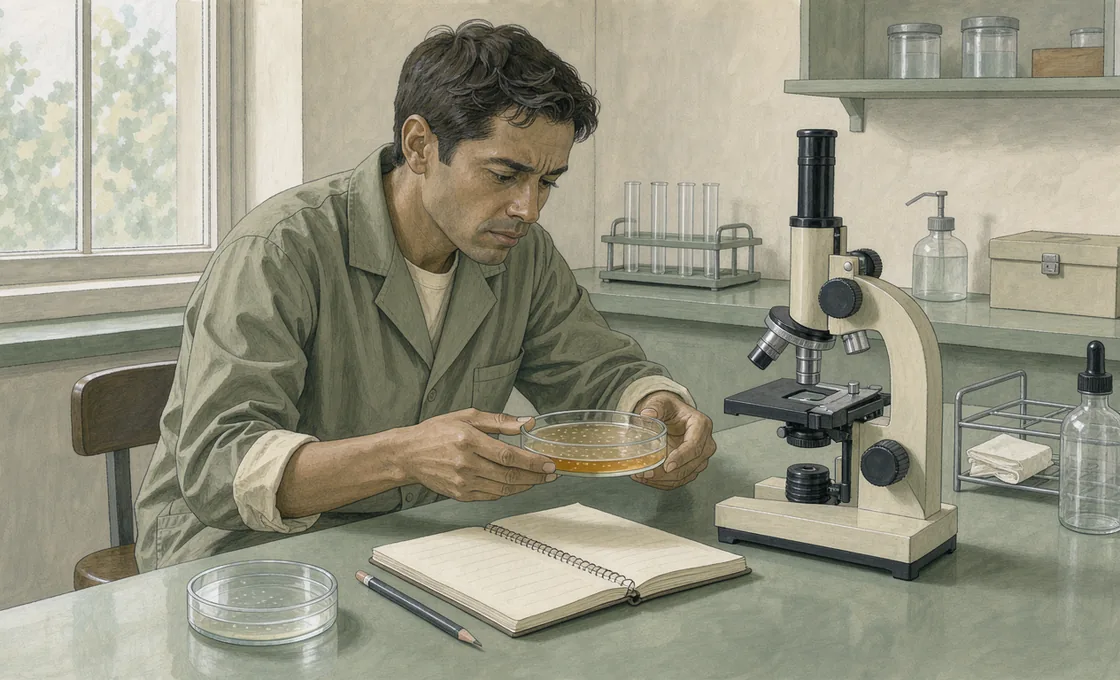
The 1988 collagen-synthesis experiment studied human fibroblasts in culture. Fibroblasts are the collagen-making cells in this experiment. GHK-Cu stimulated synthesis, and the increase occurred without a change in cell number.
That last observation wins my respect. More cells could make the total rise for a rather ordinary reason. Here, the reported response points to a change in what the cells were doing. For my money, that is a more interesting beginning than a lavish description of the finished cream.
The experiment still takes place in a culture. Its strength is the particular cellular effect it isolates, and I’d hate to lose that precision in a grander statement about skin.
The concentration response
In the same human-cell study, stimulation began between 10^-12 and 10^-11 M and maximized at 10^-9 M. These are concentrations in culture medium. Their role is to describe the experiment’s response across concentrations.
I distrust the impulse to carry those figures straight to a dressing table. The useful question here concerns a pattern within the dish: whether the cells respond, and how that response changes across the tested conditions. A facial cream introduces a different setting, including the skin barrier.
Accounting for cell number also prevents a sloppier description. The reported result concerns collagen synthesis, with cell number accounted for separately.
Collagen during remodeling
The tissue-remodeling review describes a much busier set of effects across human and animal research: collagen and elastin synthesis alongside metalloproteinases and anti-proteases. Those last names place the handling of the surrounding tissue alongside the making of new material.
The simple appeal of “more collagen” fades a little for me here. My interest shifts toward coordinated remodeling. A tissue has structure and ongoing activity; a larger quantity of an isolated component gives an incomplete picture of the work being described.
The culture experiment earns its space here on those terms. Its specific synthesis result deserves attention, while the facial cream findings carry the separate question of appearance.