Facial creams and procollagen
The most attractive percentage in the cabinet needs its outcome attached.
Subjects with increased procollagen synthesis
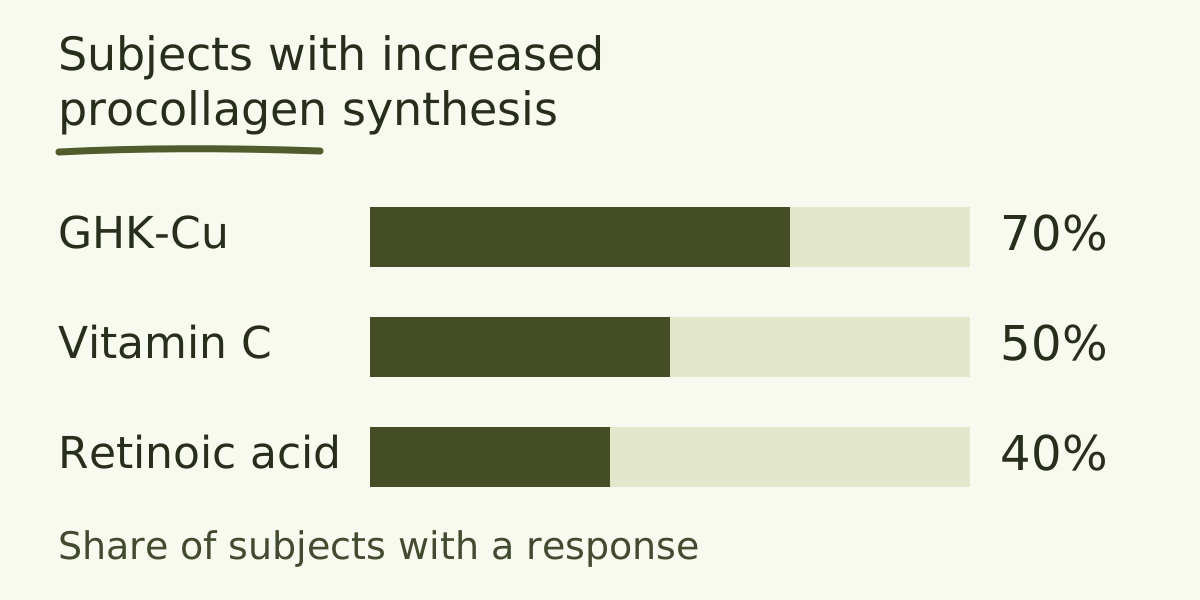
The 2025 topical GHK review reports increased procollagen synthesis in 70% of GHK-Cu-treated subjects, versus 50% for vitamin C and 40% for retinoic acid. Procollagen is the precursor being measured in that comparison.
Read as a response count, the result interests me. Read as a percentage improvement in someone’s skin, it says something the outcome never measured. The 70% describes the share of subjects with an increase. It supplies no 70% increase in collagen quantity or reduction in wrinkle depth.
I initially wanted those figures to settle a contest between ingredients. They cannot carry quite so much. A count of responders leaves the size of each response open, and a preference for a facial cream reaches beyond this biological measure.
Skin appearance in the reviews
The 2015 skin-regeneration review describes placebo-controlled improvements in skin laxity, clarity, fine lines, wrinkle depth and density. These are the appearance-related outcomes that make the cream question worth asking in the first place.
I take those reported outcomes seriously. I also resist folding them into the procollagen comparison as though all the measurements were interchangeable. A biological response and a visible change can both matter while answering different questions.
Let firmness, fine lines and the feel of a formulation retain their separate identities: that account would persuade me more. “Better skin” is too roomy a conclusion for my taste. The pleasure of a cream is allowed to be a pleasure without carrying every claim about its ingredient.
The formulation being tested
The topical review’s delivery discussion brings the cream itself back into focus. It treats poor skin permeability as a central problem and examines strategies intended to improve delivery. An ingredient’s name leaves that part of the object undescribed.
The finished formulation matters because the skin-penetration problem is physical. Changing how a peptide is presented to skin changes the experimental question. The most persuasive comparison would give the outcome and the preparation equal attention.
For the cell experiment that established a narrower reason for interest, return to collagen synthesis.